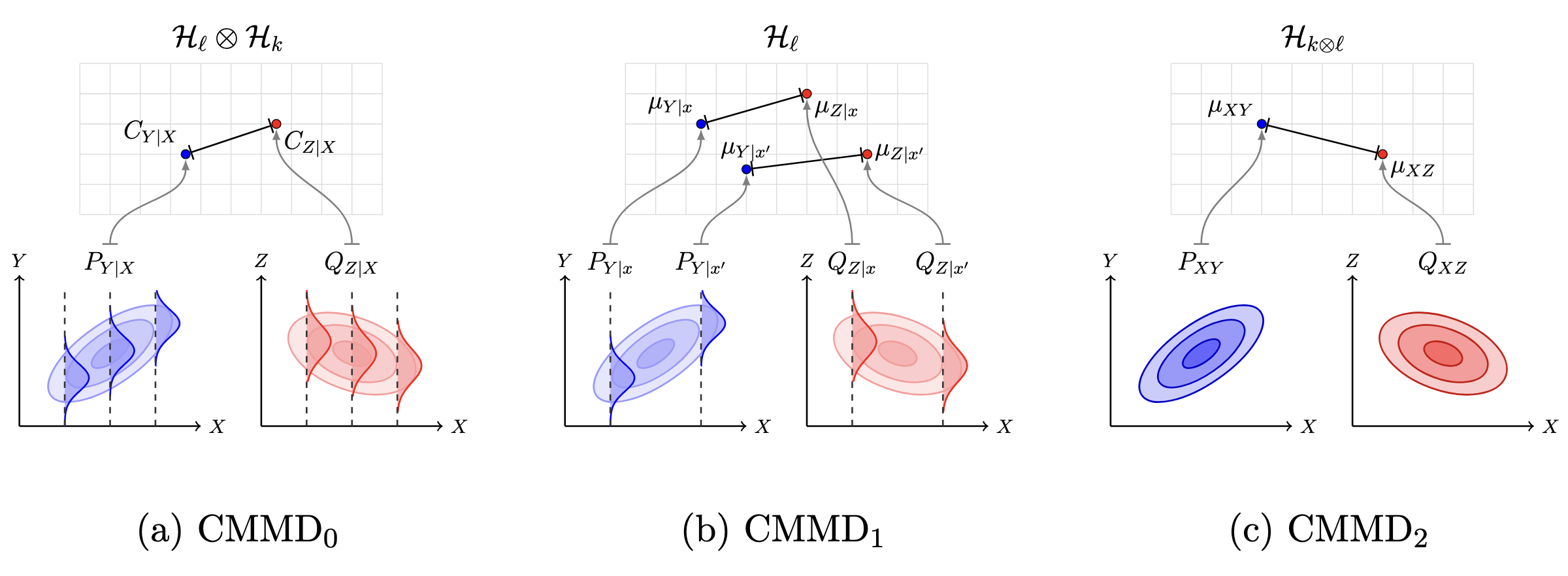
Comparing conditional distributions is a fundamental challenge in statistics and machine learning, with applications across a wide range of domains. While proposed methods for measuring discrepancies using kernel embeddings of distributions in a reproducing kernel Hilbert space (RKHS) provide powerful non-parametric techniques, the existing literature remains fragmented and lacks a unified theoretical treatment. This paper addresses this gap by establishing a coherent framework for studying kernel-based methods to measure divergence between conditional distributions through what we refer to as conditional maximum mean discrepancy (CMMD). The CMMD consists of a family of metrics which we call levels, with three special cases each using a different type of RKHS embedding: CMMD_0 (conditional mean operators), CMMD_1 (conditional mean embeddings), and CMMD_2 (joint mean embeddings). We additionally introduce a general level s CMMD, clarifying the required assumptions, and establishing mathematical connections between the levels through the lens of operator-based smoothing. In addition to reviewing previously proposed estimators, we introduce a novel doubly robust estimator for the CMMD that maintains consistency provided at least one of the underlying models is correctly specified. We provide numerical experiments demonstrating that the CMMD effectively captures complex conditional dependencies for statistical testing.
@misc{moskvichev2026kernelconditional,title={Measuring Differences between Conditional Distributions using Kernel Embeddings},author={Moskvichev, Peter and Chau, Siu Lun and Sejdinovic, Dino},year={2026},archiveprefix={arXiv},primaryclass={stat.ML},url={https://arxiv.org/abs/2605.02260},}
2025
All Models Are Miscalibrated, But Some Less So: Comparing Calibration with Conditional Mean Operators
Peter Moskvichev and Dino Sejdinovic
In Australasian Joint Conference on Artificial Intelligence (AJCAI), 2025
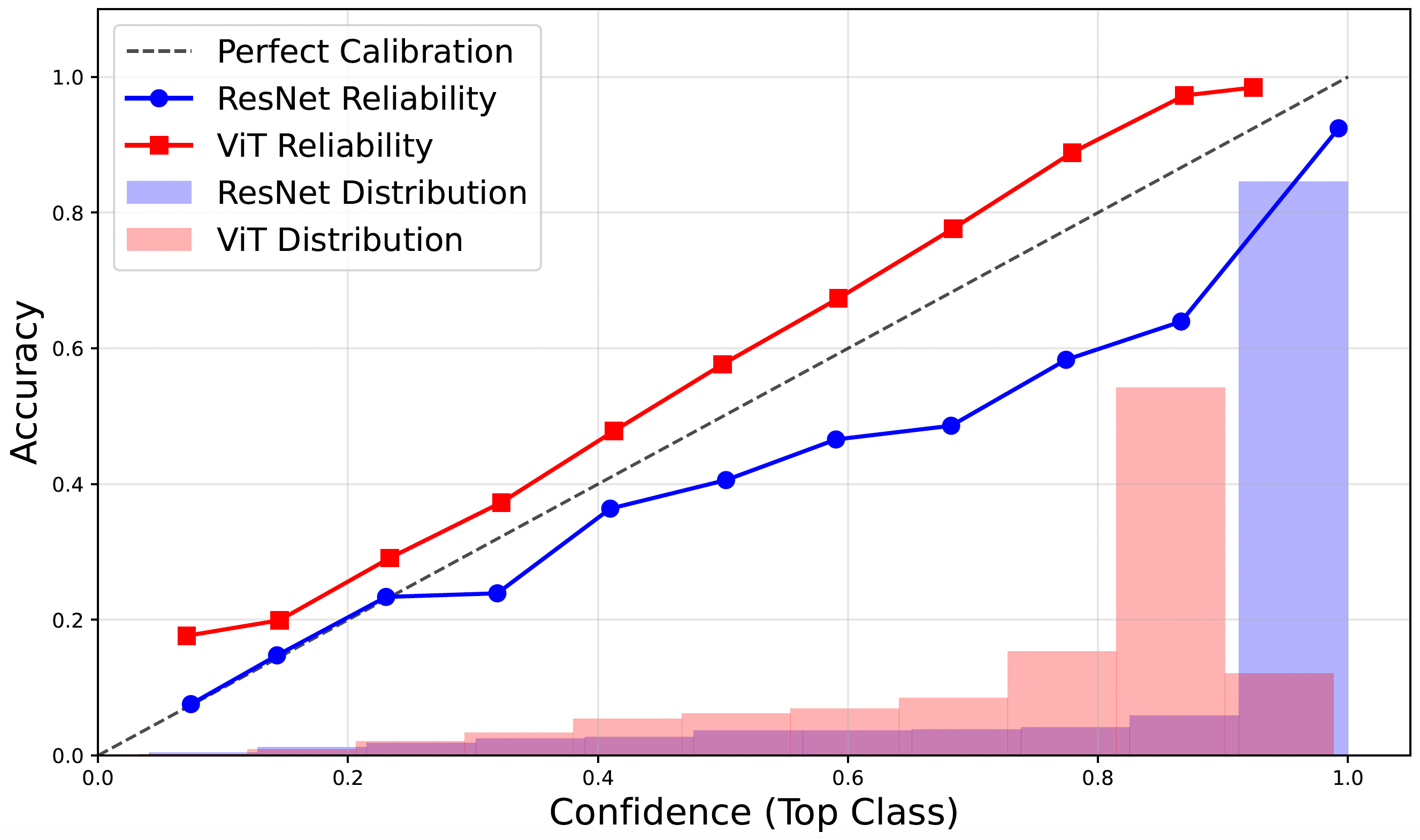
When working in a high-risk setting, having well calibrated probabilistic predictive models is a crucial requirement. However, estimators for calibration error are not always able to correctly distinguish which model is better calibrated. We propose the \emphconditional kernel calibration error (CKCE) which is based on the Hilbert-Schmidt norm of the difference between conditional mean operators. By considering calibration error as the distance between conditional distributions, which we represent by their embeddings in reproducing kernel Hilbert space, the CKCE is less sensitive to the marginal distribution of predictive model outputs. This makes it more effective for relative comparisons than previously proposed calibration metrics. Our experiments, using both synthetic and real data, show that CKCE provides a more reliable measure of a model’s calibration error and is more robust against distribution shift.
@inproceedings{moskvichev_ckce_2025,author={Moskvichev, Peter and Sejdinovic, Dino},title={All Models Are Miscalibrated, But Some Less So: Comparing Calibration with Conditional Mean Operators},year={2025},booktitle={Australasian Joint Conference on Artificial Intelligence (AJCAI)},url={https://link.springer.com/chapter/10.1007/978-981-95-4969-6_21},}
@book{przibram1967letters,title={Letters on wave mechanics},author={Einstein, Albert and Schrödinger, Erwin and Planck, Max and Lorentz, Hendrik Antoon and Przibram, Karl},year={1967},publisher={Vision},}
1956
Investigations on the Theory of the Brownian Movement
@book{einstein1956investigations,title={Investigations on the Theory of the Brownian Movement},author={Einstein, Albert},year={1956},publisher={Courier Corporation},}
@article{einstein1950meaning,title={The meaning of relativity},author={Einstein, Albert and Taub, AH},journal={American Journal of Physics},volume={18},number={6},pages={403--404},year={1950},publisher={American Association of Physics Teachers}}
In a complete theory there is an element corresponding to each element of reality. A sufficient condition for the reality of a physical quantity is the possibility of predicting it with certainty, without disturbing the system. In quantum mechanics in the case of two physical quantities described by non-commuting operators, the knowledge of one precludes the knowledge of the other. Then either (1) the description of reality given by the wave function in quantum mechanics is not complete or (2) these two quantities cannot have simultaneous reality. Consideration of the problem of making predictions concerning a system on the basis of measurements made on another system that had previously interacted with it leads to the result that if (1) is false then (2) is also false. One is thus led to conclude that the description of reality as given by a wave function is not complete.
Albert Einstein receveid the Nobel Prize in Physics 1921 for his services to Theoretical Physics, and especially for his discovery of the law of the photoelectric effect
This is the abstract text.
@article{einstein1905photoelectriceffect,title={{{\"U}ber einen die Erzeugung und Verwandlung des Lichtes betreffenden heuristischen Gesichtspunkt}},author={Einstein, Albert},journal={Ann. Phys.},volume={322},number={6},pages={132--148},year={1905},doi={10.1002/andp.19053220607},}